
The European Union is undergoing one of the most significant transformations of its customs framework in decades. Driven by the surge in e-commerce, increasing regulatory requirements, and geopolitical pressures, the reform aims to modernize how goods enter and move across the EU.
Why change was needed?
Importers in the EU currently navigate 27 separate national customs administrations and over 100 different IT systems, exposing a fragmented, costly setup. On top of that, the exponential increase of e-commerce has exposed a new challenge for customs authorities: an estimated 5.9 billion low-value parcels entered the EU in 2025, the vast majority originating from China and often benefiting from duty exemptions that were never designed for this scale.
Added to that, the need for a customs reform also derives from the growing complexity of sanctions enforcement, product safety rules, environmental legislation, and global disruptions.
What is changing?
On 25 March 2026, the European Parliament and the Council reached a formal agreement on the EU Customs Reform, following a proposal the Commission had first tabled in May 2023. The reform is designed to modernize both the architecture and governance of EU’s customs system and is built on three conceptual pillars that are based on the following key technical developments.
Together, these changes outline a new customs model built around a common data infrastructure, closer cooperation between authorities and businesses, and a reallocation of responsibilities across the supply chain, with differentiated impacts depending on the type of operator and transaction.
A new partnership with business
To improve their competitiveness, businesses need to bring goods into the EU as quickly as possible and avoid administrative burdens. The ability to register all information about their products and supply chains on a single online platform allows them to achieve this goal and strengthens the existing Authorized Economic Operator (AEO) program for trusted business operators.
The EU Customs Data Hub
It is the technological backbone of the reform. The Data Hub will serve as a single-entry point for all customs-related data, replacing the patchwork of national IT systems. For businesses, this means submitting information once across the entire EU, no matter where goods cross the border. The system will apply AI and machine learning to enable smarter, earlier risk assessment, including the ability to flag non-compliant shipments before they even depart for the EU. While authorities will gain real-time visibility across supply chains and better tools to conduct risk analysis, the expected impact on operators involves less administrative burden, faster clearance, and more predictable processes.
Trust & Check Traders
A new category of highly compliant operators, Trust & Check Traders, will be created, similar in spirit to the existing AEO framework. Businesses that offer full supply chain transparency will benefit from smoother clearances, fewer inspections, and significantly less administrative burden, including the possibility, under certain conditions, to import without active customs intervention, or periodic duty payments instead of per shipment, bringing significant cost and time savings for compliant operators.
A smarter approach to customs checks
While Data Hub feeds data into this new system to provide customs authorities with information on the supply chains and production processes of goods intended for importing into the EU, AI will also be used to analyse and anticipate problems before the exit of goods from the exporting country.
A New EU Customs Authority (EUCA)
A centralised agency to be headquartered in Lille, France will coordinate and modernize risk management, data analysis, and implementation of EU customs legislation across all Member States with the aim of preventing the entry into the Union of dangerous or illegal goods and enforcing the growing number of EU laws that prohibit certain products that violate the higher values protected by the EU.
Rather than 27 authorities acting independently, the EUCA enables them to act as one: sharing intelligence, identifying threats, and designing coordinated controls in real time.
It will also coordinate EU-level crisis management in the area of customs when national customs must react quickly and in a coordinated way due to a major disruption or risk (security threats, geopolitical crises, supply chain disruptions, etc).
Changes in E-commerce
Changes to e-commerce regulations shift the current responsibility for complying with customs obligations from consumers and transport companies to online platforms and marketplaces. These actors will be responsible for ensuring the payment of customs duties and VAT as well as for ensuring product compliance at the time of purchase, so consumers will no longer be affected by hidden charges or unexpected procedures upon receiving their package.
In this way, EU consumers can be confident that all duties are paid and that their purchases are secure and comply with EU environmental, safety, and ethical standards.
The Reform also sets up two key developments that directly affect e-commerce:
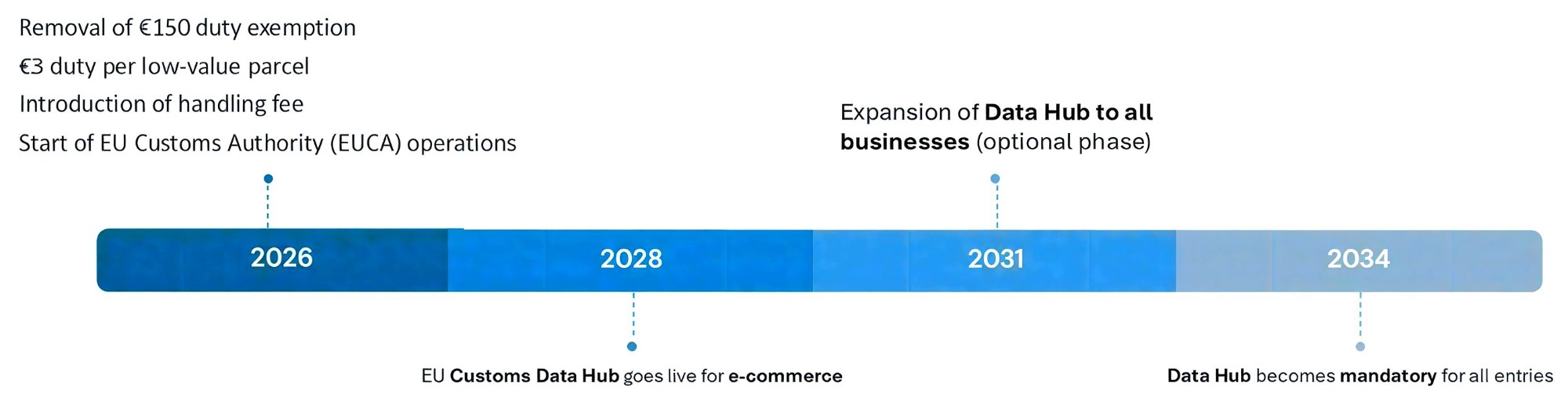
- The long-standing rule that exempted parcels valued under €150 from customs duties is abolished. From 1 July 2026, a flat customs duty of €3 per parcel will apply to low-value items imported into the EU. A handling fee covering IT and labour costs for customs processing will follow and is expected by the end of 2026.
- The simplification of customs duty calculation for the most common low-value goods bought from outside the EU, reducing the high amount of customs duty categories down to only four. This makes it much easier to calculate customs duties for small parcels, helping platforms and customs authorities alike to better manage the vast number of e-commerce purchases entering the EU each year. And it will also remove the potential for fraud.
EU Customs Reform timeline at a glance: What happens when
What to expect and how to prepare?
At its core, the reform represents a structural shift in how customs operate:
- from transaction-based declarations to continuous data sharing,
- from nationally fragmented processes to EU-wide coordination, and
- from reactive controls to proactive, intelligence-led risk management.
This is not merely a procedural update. In fact, the Customs Reform represents a fundamental change in the way trade and customs authorities interact.
For businesses that adapt early, the upside is significant. Compliance costs are estimated to fall by €2.7 billion per year across the EU, while faster clearance times and greater predictability will reduce friction across supply chains. The move to a data-led system also means more targeted enforcement against non-compliant competitors, levelling the playing field for operators who invest in transparency and good data practices.
The complete reform is ambitious in scope and long in timeline, but its first concrete steps are already months away. Businesses that invest early in digitalisation, data quality, and compliance readiness will be better positioned to benefit from the system's rewards and avoid its penalties.
The window to prepare is open, and it is worth taking advantage of it.
Open questions: structural risks and implementation challenges
While the EU Customs Reform represents a significant step forward in modernising customs operations, the scale and ambition of the project also raise significant risks and structural challenges.
Governance by a single Customs authority against disparities between Member States
One of the main concerns relates to governance and institutional design. The concentration of risk management, data analysis, and legislative coordination within the EUCA raises questions about administrative capacity and operational efficiency at scale. Centralized decision-making may reduce responsiveness to local trade conditions and the EUCA's broad mandate across the 27 Member States can lead to delays in administrative processes. The proposed harmonisation of customs sanctions across the EU also presents a significant legislative challenge, given the structural differences between Member States that operate under administrative penalty frameworks and those that apply criminal law.
The absence of a common legal framework for customs infringements and sanctions results in legal uncertainty for economic operators as well as in potential supply chain disruptions, when they should be supported by clear, stable, coherent, predictable and practical customs legislation instead.
Cybersecurity of the Data Hub
Centralising vast amounts of sensitive commercial and supply chain data in the EU Customs Data Hub increases exposure to cyber threats, data breaches and potential misuse of information. A major technical failure or cyber incident could disrupt trade across the entire European Union, particularly for time-sensitive or high-risk goods.
Ensuring robust safeguards, clear data access rules and strict accountability mechanisms will be essential to maintain trust in the system.
Unrealistic timeline and technological obsolescence
Timeline and technological obsolescence are also emerging as critical risk areas. Given the current pace of development in AI, machine learning, and supply chain technologies, the long implementation timelines, stretching until 2038, might be obsolete by the time the system becomes fully operational and mandatory.
Exclusion of SMEs
Also, SME adaptation capacity may be a challenge faced by the reform. The stricter requirements for Trust & Check Trader status could sideline SMEs reducing their competitiveness against large operators with more advanced resources or make compliance excessively burdensome. This could potentially create barriers to entry and/or reinforce competitive imbalances.
Challenges for the e-commerce sector
- The shift of responsibility to e-commerce platforms raises issues of enforcement and liability regarding security and duty payments in complex global supply chains where multiple stakeholders are involved.
- The removal of the €150 tax-free threshold will almost certainly lead to a sharp increase in the volume of declarations for customs offices, especially in countries with high levels of e-commerce activity like Germany, France, and the Netherlands.
- The introduction of a €3 management fee instead (starting July 2026), will probably lead to higher final prices for online purchases from outside the EU.
The EU customs reform is ambitious in scope and far-reaching in its practical implications, but, as mentioned earlier, it can be concluded that there are still unresolved issues:
| KEY QUESTIONS | |
|---|---|
|
1
|
Will economic operators be able to systematically provide high-quality data that enables risk management based on artificial intelligence? |
|
2
|
How will customs authorities address the compliance gap between large companies and small traders? |
|
3
|
Are cybersecurity and data control measures sufficient for a fully centralised customs data infrastructure? |
|
4
|
Is it possible to achieve coordinated enforcement of customs legislation and sanctions across the 27 Member States without creating new bottlenecks during the transition period? |
These questions suggest that the reform’s success will depend not only on legal changes, but also on effective execution, governance and sustained cooperation between customs authorities and the private sector. Future analysis will examine how these challenges are being addressed as implementation progresses.
Further information:
- EU Customs Reform
- EU Commission – Press release: Commission welcomes historic agreement to reform EU Customs Union
- Council of the EU – Press Release: Council and Parliament agree on landmark reform
- EU Commission – Questions and answers on the EU Customs Reform
- Digital Aspects of Customs Control in the New European Customs Reform Initiative