
Accepted in 81 countries and Customs territories, the ATA Carnet is the document most widely used by the business operators for their international operations involving temporary duty-free admission of goods. It helps to streamline the Customs process by utilizing unified, ready-to-use declaration forms and eliminating the lodging of a guarantee, bond or cash deposit in the country of temporary importation or transit.
Overall implementation model
Just before the COVID-19 pandemic the International Chamber of Commerce (ICC) launched a digital ATA Carnet System in the form of a pilot version which has been tested and upgraded over the last few years with the aim of validating system, workflows, and legal feasibility.
Production system was launched in July 2023 and national customs and issuing associations have been working since then on the preparation of IT systems.
Operational deployment started in 2026 and the WCO Secretariat has just reported that the customs administrations of the European Union, Norway, Switzerland and the United Kingdom have confirmed their readiness to activate the eATA Carnet system deployed by the International Chamber of Commerce (ICC).
First phase (from June 2026)
From 1 June 2026, the eATA system will go live in these customs territories (30 countries), marking the beginning of the global transition to the digital ATA carnet. Consequently, the global issuing network must be prepared for the issuance of digital ATA carnets to these territories from that date.
From that moment on, the digital ATA carnet will progressively replace the paper format as an operational document for customs transactions, and the customs authorities will ask the holder to present the corresponding QR code for processing, which represents a significant change for all users of the system.
Second phase (from late 2026 onwards)
From late 2026, countries outside Europe will gradually be included. For instance, the United States is expected to join in the second half of 2026, with other ATA countries following suit progressively.
The ICC looks forward to onboarding all other ATA countries by 2027, the timeline expected by the WCO ATA/Istanbul Convention Administrative Committee.
What is the digital ATA Carnet System?
The ATA Carnet System was built as a set of various digital tools, tailored for a range of stakeholders. It includes:
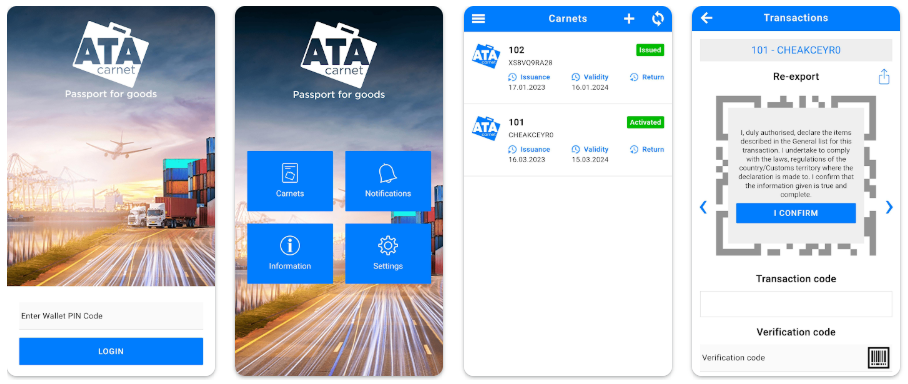
- A smartphone application, the ATA Carnet app, enabling operators to carry and declare digital versions of their Customs documents.
- An application called ATA Carnet Customs (ACC), enabling Customs officers to verify Carnets and approve digitally declared transactions.
- The ATA Carnet Core, a global database used by national Guaranteeing Associations (NGAs).
- The ATA Gateway, a lightweight issuing module made available to NGAs and IAs to issue paper and digital Carnets.
What is the process of issuance of a digital ATA Carnet?
This is a practical summary of how a digital (eATA) Carnet is issued:
- Application by the holder: the company/individual applies to the national guaranteeing association (NGA) (e.g. Chambers of Commerce) and submits all the operational details and supplementary documents online via the national eATA platform.
- Validation of the guaranteeing association: the NGA checks eligibility, operation details, documents and compliance with ATA Convention rules and national procedures. It also assesses risks and may request a guarantee/security.
- Payment and guarantee: the holder pays issuance fees and provides a financial guarantee.
- Digital carnet creation by the NGA in the eATA central system.
- Delivery of the eCarnet to the holder: via eATA mobile application or web access the holder receives:
- a digital carnet file
- a QR code/secure identifier
- Activation of the eATA Carnet: the holder presents the QR code via app and the Customs validates the carnet electronically and records the first transaction (export); this replaces stamping/signing of paper vouchers.
What are the advantages of digital carnets?
The ATA Carnet presents the following advantages of the use of digital ATA Carnets:
- they are easier to use than paper carnets
- they reduce queues at the border
- they reduce financial risks as the document cannot be lost
- they provide full visibility of where the goods are
- they imply 24/7 worldwide support once it goes live
- they are environmentally friendly
In practical terms, this new system involves the transition from a system based on the sealing of a notebook in paper format – consisting of a cover, back cover, matrices and flyers of different colours – to a system based on the scanning or reading of QR codes associated with the different operations carried out under the cover of an ATA carnet (validation, temporary export, temporary import, re-export, re-import and transit).
The ATA Carnet procedure is expected to be fully digital by the end of 2027, so all Contracting Parties will need to prepare for such digitisation.